

Which pH meter should I choose?
Given the wide range of instruments available, it can be hard to choose the right one.
First, decide whether the instrument should be portable or benchtop.
Benchtop instruments offer more comfort and accessories than portable ones.
Portable ones are faster and more rugged, designed to withstand the battles of the field.
Finally, pH pen testers are pocket-sized portable instruments, inexpensive, with a very fast response, suitable for those who need less accuracy.
Choosing the right electrode…
There are many types of electrodes: the body material, the reference, the internal electrolyte, the junctions and the diaphragms can all vary.
To start, you need to know the type of sample to be analysed, and then identify the correct electrode.
If you are not sure about the choice, or the sample does not appear among those listed, we recommend contacting us for advice from a specialised operator.
The correct electrode, besides ensuring more precise measurements, will last much longer than an electrode unsuitable for the sample being analysed.
How can I measure pH as accurately as possible?
To measure pH as accurately as possible, we recommend calibrating frequently, using fresh buffer solutions.
The temperature of the buffer solutions should be as close as possible to that of the samples that will later be measured.
The pH electrode also needs to acclimatise, so we recommend leaving it immersed in buffer solution for a few minutes before starting calibration.
As a final but no less important note, the best measurement is obtained by keeping the sample under gentle stirring, so as not to create bubbles, in order to homogenise the solution.
Commissioning the pH electrode
Normally the electrode is delivered ready to use: just connect it to the instrument, remove the protective cap (which contains Storage solution), rinse with distilled water, calibrate and proceed with the measurements.
However, it can happen that the electrode appears "asleep" at first, not very reactive and slow to stabilise. In this case we recommend immersing the electrode in KCL solution, or in pH 4 buffer solution, for at least two hours. This reactivates the membrane, and the electrode will be ready to be calibrated.
Why calibrate?
Calibrating means "adjusting" the reading of our measurement chain.
To do this you need buffer solutions of known value (different families exist).
It is important that the solutions are fresh and uncontaminated, because we must be sure that the value is the one stated on the package.
How often should I calibrate?
In purely theoretical terms, for perfect results, we should calibrate the instrument before every measurement.
In reality it is enough to calibrate the instrument at a periodic frequency that suits the needs of the application: the more accuracy we seek, the more frequently we will have to calibrate the instrument.
The calibration procedure takes a few minutes, and doing it frequently does not damage the instrument in any way.
What is automatic temperature compensation and why do I need a temperature probe?
Temperature plays a significant role in pH measurement.
As the temperature rises, molecular vibrations increase, which translates into the water's ability to form more hydrogen ions. Consequently, the pH will drop.
In practice, as the temperature varies, the pH value varies.
A common oversight is to take a sample from a process tank and measure its pH in the laboratory.
Once in the laboratory, the sample's temperature will have changed, and consequently its pH value will also be different.
Different, but not wrong. It will be the correct pH value at the new temperature.
We can therefore deduce that a pH value without a temperature value is meaningless, and the way to avoid errors is to always report the pH and temperature of the sample at the time of analysis.
Temperature, besides modifying the characteristics of the solution, also affects the performance of the electrode.
While predicting the behaviour of the solution is impossible, it is instead possible to predict what will happen to the electrode.
Automatic compensation comes to our aid.
As the temperature varies, the electrode's mV response also varies, this time causing a real error.
pH instruments with temperature compensation take this error into account and correct it.
Without an automatic temperature probe, the solution temperature must be entered manually into the pH meter in order to correct the measurement.
The further the sample's pH is from pH 7, the more important automatic temperature compensation becomes, especially in the alkaline range.
To remember: for the best results in pH measurement, calibrate and measure at the same temperature.
NB: pH decreases as temperature increases. But this does not mean that water becomes more acidic at higher temperatures. A solution is considered acidic if there is an excess of hydrogen ions over hydroxide ions. In the case of pure water, there is always the same concentration of hydrogen ions and hydroxide ions, and therefore water is still neutral (even if its pH changes). At 100 °C, a pH value of 6.14 is the new neutral point on the pH scale at this higher temperature.
What is the best way to
store my pH electrode?
It is essential to store the electrode in the Storage solution, a liquid designed to keep the membrane hydrated and ready for use.
The electrode is supplied already immersed in Storage solution, which however must be replaced after a few days. It is therefore advisable to buy a spare bottle.
If stored dry, the electrode will become extremely slow and unstable, until it is completely exhausted.
Never store in water!
How long does the pH probe last and what can I do to make it last as long as possible?
Cleaning the electrode (with water and neutral soap) and storing it correctly in the storage solution are the basic operations to extend the life of the electrode as much as possible, which generally ranges from 9 to 24 months depending on the application. Solvents, acids, corrosive chemicals and high temperatures are the worst enemies of the pH electrode.
You must select the appropriate electrode based on the sample to be analysed.
How do I know when it is time to replace the pH probe?
When readings become slower or more unstable and it is no longer possible to calibrate the electrode, it may be time to replace it.
Ultrapure water compensation
Do you have difficulty measuring the pH of distilled, deionised or ultrapure water?
The reason is that distilled, deionised or ultrapure water contains very few hydrogen ions, and the electrode therefore struggles to capture them.
This causes unstable, fluctuating measurements.
Tap water, on the other hand, contains a sufficient number of hydrogen ions, so pH readings are much easier.
We must also keep in mind that water (distilled, deionised, ultrapure, etc.) does not necessarily have a pH equal to 7.00. Contact with air generates carbonic acid (H2CO3) which acidifies the pH value.
To correctly measure the pH of treated water, the "Ultrapure water compensation" function becomes essential, present in our XS Series 80 and in the XS Revio multiparameter.
The instrument takes into account the ionic strength of the water and returns a much more accurate measurement.
Why measure conductivity
Conductivity tells us how well the solution is able to conduct electricity.
This characteristic is mainly due to the salts and minerals dissolved in the solution, so through the conductivity measurement we get an indication of how many elements are dissolved in our solution.
How conductivity is measured
The measurement requires a conductivity sensor and a temperature probe (normally integrated in the same body).
After calibration, the sensor is inserted into the solution and the measurement is taken. Modern measuring instruments, like the entire XS Instruments line, measure the conductivity and temperature of the sample, and then return the result already normalised to 25 °C (or any temperature chosen between 15 and 30 °C).
As the temperature varies, the measurement varies, but unlike pH, for conductivity it is possible to predict this variation exactly.
How can I clean and store the probes for my conductivity meter?
Clean the probes by immersing them in ethyl alcohol for a few minutes to remove any grease films from the sensors.
NEVER rub.
Rinse the probes thoroughly with distilled or deionised water and recalibrate the meter before use.
Unlike pH and ORP sensors, conductivity meters can be stored dry.
How do I calibrate the conductivity meter, and how often?
Consult the manual for your specific instrument for the calibration procedure.
Select the calibration solution from the commercially available standards, choosing the values closest to the expected conductivity value of the samples under examination.
The most common standards are 84 uS, 1413 uS and 12.88 mS.
The frequency depends on the accuracy you wish to obtain, the type of sample analysed and the working methods.
In general we recommend calibrating the instrument at least once a week, in the case of frequent use of the instrument.
What does the cell constant mean?
The cell constant (C) is the distance/surface ratio of the conductivity sensors.
In two-ring cells there are normally three possible variants:
C= 0.1 : for low conductivity measurements (<100 uS)
C = 1: for medium-value measurements
C = 10 : measurements of high conductivity values (>20 mS)
It is important to choose the right cell based on the expected values, and to set the correct cell-constant value on the instrument.
Why measure dissolved oxygen?
Dissolved oxygen (DO) can indicate the health or quality of water.
Oxygen is essential for aquatic ecosystems and some chemical reactions, but too much oxygen can also be harmful to ecosystems.
What affects DO levels in water?
The concentration of dissolved oxygen in water is affected by:
Water temperature - levels fall in warm temperatures
Mineral waters - oxygen is less soluble in water with high salinity levels
Atmospheric pressure - reduces oxygen pressure at altitude;
An oximeter should take all these parameters into account.
What is the difference between polarographic and optical sensors?
Polarographic sensors need to warm up before calibrating in order to polarise the electrodes.
The optical sensor, on the contrary, is always ready to work and does not require polarisation times.
In addition, the optical sensor requires no maintenance, while the polarographic one requires regular maintenance, cleaning and electrolyte refilling.
How often should I calibrate the oximeter?
It is not possible to establish in advance how often to calibrate it. Theory tells us that, for perfect measurements, it should be calibrated before every measurement. The more frequently you calibrate, the more accurate the measurements will be.
How do you calibrate an oximeter?
The XS oximeter is calibrated in air, with a value equal to 100% dissolved oxygen.
Calibration does not require calibration solutions, takes a few seconds and can be done as many times as you like.
It is also possible to linearise the scale by calibrating on a second point (0%) using disposable solutions.
This procedure can be done much less frequently.
How often should I change the sensor membrane?
In general the membrane tends to become contaminated and to deteriorate differently depending on how it is used.
We recommend always having a spare membrane ready for use.
When measurements become unstable or too slow, or when calibration in air returns an error, then it is time to replace the membrane.
In polarographic sensors the membrane deteriorates earlier than in optical sensors.
When and how should I clean the sensor?
The sensor should be cleaned at the end of each measurement, rinsing with distilled water.
If necessary, carry out maintenance as described in the instrument manual.
How do you program the datalogger?
By following the link below you will find a short video explaining the configuration and data-download steps of the datalogger:
https://www.youtube.com/watch?v=6v9CR9cuhHY&feature=emb_title
Is there an accuracy certificate for the instrument?
YES. Once the datalogger is inserted into the computer and the zLoggManager program is opened, near the datalogger serial number in the "Configure" menu there is the Statement of Accuracy link; clicking on the link opens the PDF file containing the manufacturer's accuracy certificate.
Once the data has been downloaded / the datalogger stopped, how do I resume / start a new recording?
Once the data has been downloaded and saved to the PC, the datalogger must be reprogrammed using the zLoggManager software.
When the datalogger is taken out of the freezer the screen is off (XS Mini T).
The XS Mini T dataloggers automatically turn off the screen once they reach -10 °C to preserve operation. It will turn back on / reactivate once the datalogger's temperature is again higher than -10 °C.
The datalogger did not start at the set time but N hours later / the datalogger recorded but the time is wrong by N hours, why?
Check that the time zone selected in the software settings is correct: File > Preferences > Time Zone
How can I tell that a datalogger is recording?
The LCD screen contains icons to quickly inform the user about the current status of the datalogger.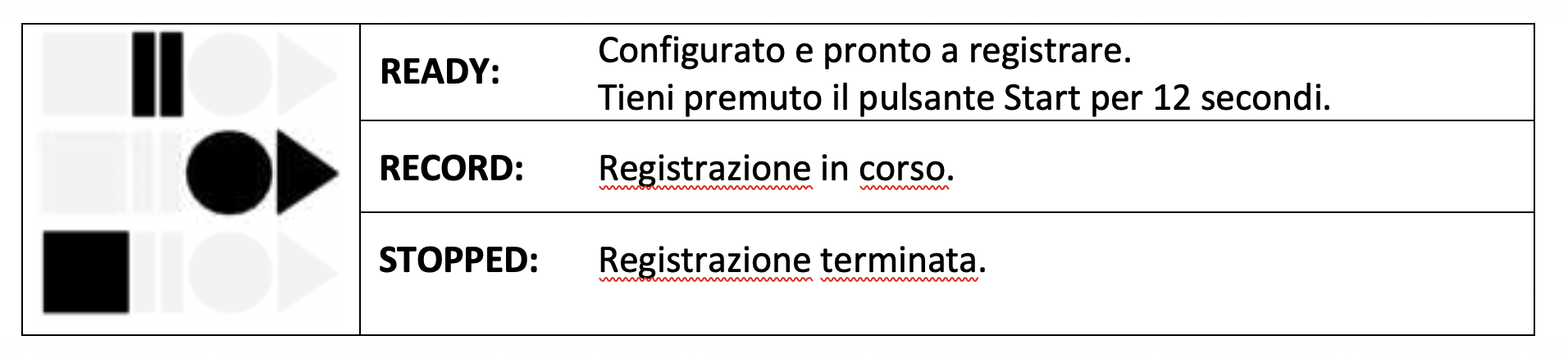
How long do the datalogger batteries last?
Battery life varies depending on the use of the datalogger, from 6 to 12 months.
Is the value shown on the display the instantaneous measurement?
No, the display shows the data relating to the last recording taken and is updated every X time, based on the set acquisition interval.
Once the data has been downloaded / the datalogger stopped, how do I resume / start a new recording?
Once the data has been downloaded and saved to the PC, the datalogger must be reprogrammed using the Escort Console software.
I can't find the PDF file with the data. During programming, select the option to create the PDF file.
I set magnet start but it does not start, it stays "ready" on the screen. The magnet is not the USB communication cradle, but a support that can be purchased separately. In any case you can try with a medium-strength magnet; the datalogger should start recording without problems.
How long do the datalogger batteries last?
Battery life varies depending on the use of the datalogger, from 6 to 12 months.
Is the value shown on the display the instantaneous measurement?
No, the display shows the data relating to the last recording taken and is updated every X time, based on the set acquisition interval.
General characteristics of the various sensors? (PT100, Thermocouples, NTC)
A Pt100 probe is a platinum resistance thermometer with a nominal resistance of 100 Ω at a temperature of 0 °C. The main characteristics of these probes are: excellent accuracy, greater stability, an almost linear characteristic curve, and a medium-low temperature range.
A thermocouple consists of two different metals joined at one end. When the junction of the two metals is heated or cooled, a temperature-related voltage is produced, detected using a thermometer suitable for the purpose (a thermocouple thermometer). Thermocouples can be of different types: K, J, T, E, N, B, S, R. They differ in the type of metals they are made of and in their field of application. Type K: Chromium and Nickel. The connector is yellow. Type J: Iron and Constantan. The connector is blue. Thermocouples reach much higher temperatures than PT100 sensors.
A thermistor sensor or NTC probe is a temperature-sensing element made of a sintered semiconductor material which, in response to a small change in temperature, shows a large resistive change. Its working range is limited compared to PT100 and Thermocouple temperature probes.
Below is a table with the technical specifications relating to the different types of sensor. On the right-hand side, the graph shows the percentage of the actual temperature value on the x-axis and the time expressed in seconds on the y-axis. Noting the characteristics shown in the table and the graph, a simple conclusion can be drawn: PT100 sensors are more accurate than thermocouples but are slower to reach the real temperature. Thermocouples, on the other hand, are the opposite, i.e. they are less accurate but much faster.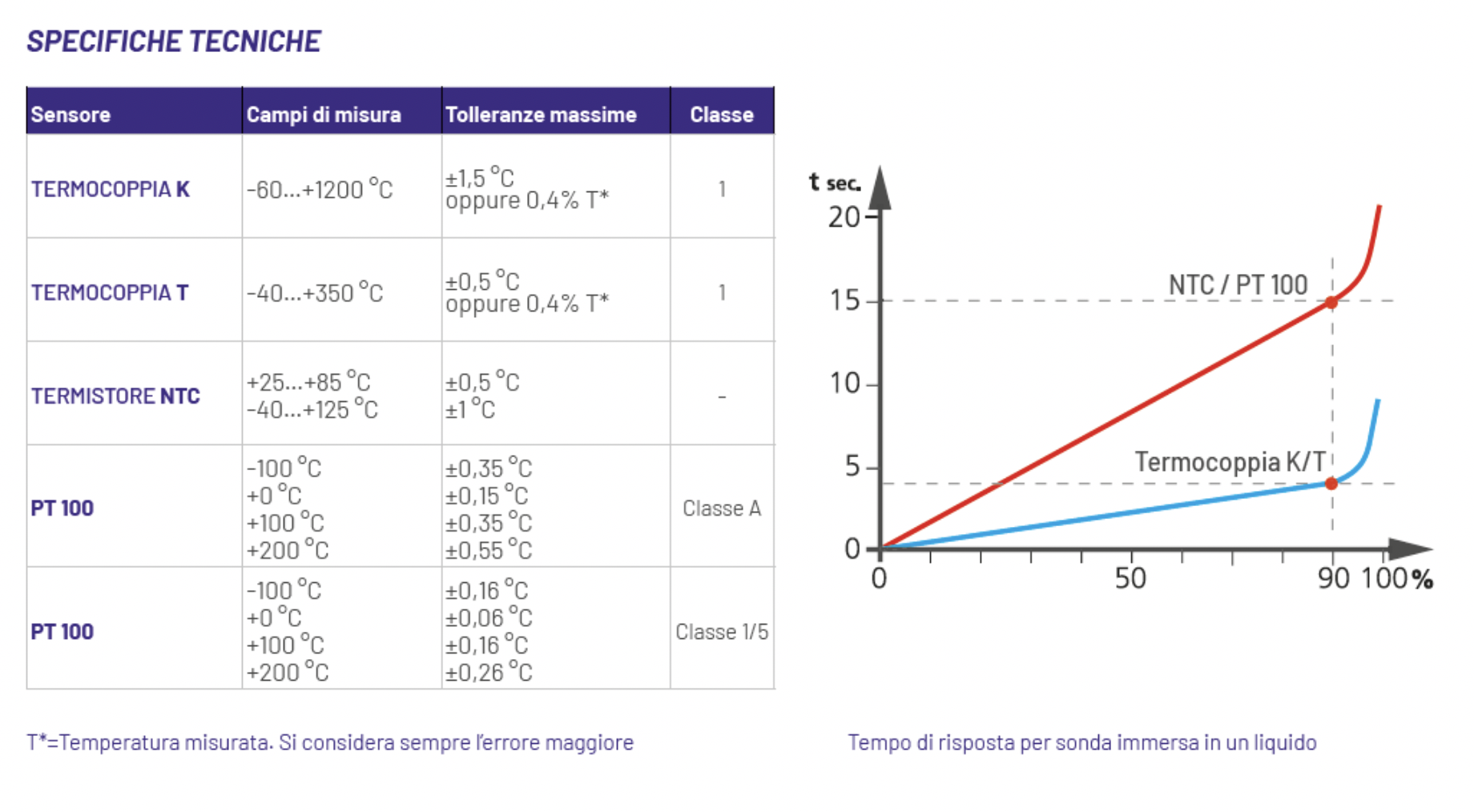
Choosing the temperature probe...
Choosing the temperature probe is a delicate operation, as you will have to focus your attention on a few points to find the sensor suitable for your application.
The following list will help you choose the correct sensor:
if you already have a thermometer, check the type of probes it detects and the type of connector;
if you do not have a thermometer, choose the sensor based on your application. Cable length;
Stem length;
Stem diameter;
Measuring range;
Type of terminal (Air/liquids, Penetration or Contact).
This information is necessary to understand the type of probe that needs to be used. If the desired probe is not in the price list/brochure, we invite you to send an email to assistenzatecnica@giorgiobormac.com with all the characteristics listed above and the relevant values, and with the help of our technicians a solution will be found, if possible.
How long does an Accredia certificate last?
The certificate has no expiry date and there is no deadline by which a new calibration must be carried out.
The choice of the calibration interval must be made based on several variables. The user's Quality Register must also be taken into account.
Sometimes calibration is requested annually, while in other cases biennial certification is adopted.
Are checker thermometers Accredia-certifiable?
Given the cost of the thermometers, Giorgio Bormac s.r.l. does not send such thermometers for certification. We recommend purchasing a higher-level instrument if the user needs an Accredia certificate. ·
Can I use infrared thermometers to measure the temperature of liquids and reflective surfaces?
When a shiny, reflective surface or a liquid is measured, radiation coming from other sources and reflected by our sample is collected. The result shown by our thermometer will therefore be a distorted reading.
A solution can be applied to shiny/reflective surfaces, where possible, by placing an opaque target on our sample and measuring its temperature after a sufficient dwell time so that target and sample are at the same temperature.
For example, if you want to measure the temperature of a glass bottle, simply apply a paper label to the bottle and "shoot" at it.
What does D:S mean in infrared thermometers?
"D" means distance and "S" means spot. That said, D:S is simply the ratio between distance and target.
If our thermometer has a D:S of 11:1, it means that at a distance of 110 cm from the target, we will measure the radiation of an area of 10 cm in diameter on it.
What is emissivity in infrared thermometers?
Emissivity is a measure of the efficiency of the surface emission of thermal radiation.
It is a value without a unit of measurement and its value can vary from 0 to 1. In some infrared thermometers it is possible to change this value, while in other cases the value is fixed at 0.95, a typical value for most surfaces.
Which IR thermometers should be used to measure body temperature?
Not all infrared thermometers can be used to measure body temperature because the accuracy value is not high enough.
Since 2020 Giorgio Bormac s.r.l. has introduced the BodyTemp thermometer for measuring body temperature (and surfaces). This thermometer is classified as a medical device (CND), which can be consulted on the Italian Ministry of Health website.